


Evidences Petasites albus
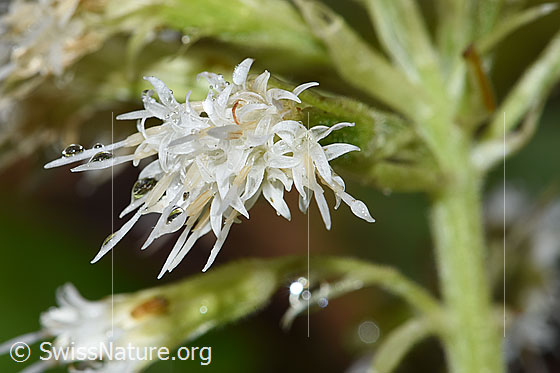
| Name: | Petasites albus |
| Family: | Asteraceae |
| Genus: | Petasites |
Relationships with other species
On the flower 'Petasites albus' we could document so far among other things:

Habitats and communities
The flower Petasites albus we could document in the following habitats, among others:
Inconspicuous place in the valley bottom of a hilly landscape
Region: Emmental, Switzerland
Height: 950m ASL
All photos
Region: Emmental, Switzerland
Height: 950m ASL
All photos


Distribution
So far, we have been able to observe and document photographically the species Petasites albus at altitudes of 950m to 1060m above sea level.
We have so far been able to observe and document photographically the species Petasites albus between 6. March and 21. April.
So far we have been able to add 6 observations of this species to the database.
Ecological indicator values according to ©Landolt et al. (2010) for Petasites albus
| Climate | Temperature number T | 3i | Montane, small variation. |
| Continentality K | 3i | Suboceanic to subcontinental, small variation. | |
| Light number L | 2i | Shade, small variation. | |
| Soil | Moisture number F | 4i | Very moist, small variation. |
| Moisture variability W | 3 | Moisture strongly varying. | |
| Reaction number R | 3i | Weakly acid to weakly neutral, small variation. | |
| Nutrients number N | 4i | Fertile, small variation. | |
| Heavy metal tolerance M | m | Heavy metal tolerant. | |
| Humus number H | 3i | Moderate humus content, small variation. | |
| Aeration D | 1i | Bad aeration, small variation. |
Legend:
The exact description of the factors and values can be found in the book «Flora indicativa».
The exact description of the factors and values can be found in the book «Flora indicativa».
Source: Book «Flora indicativa»
Threats
The threat to the species Petasites albus is LC: Not endangered.
Source: Red List of Vascular plants, Switzerland , Edition 2016